howthings.work · a picture encyclopedia for small children
The Cell
Inside a human cell · by @virpo
Open the interactive cut-away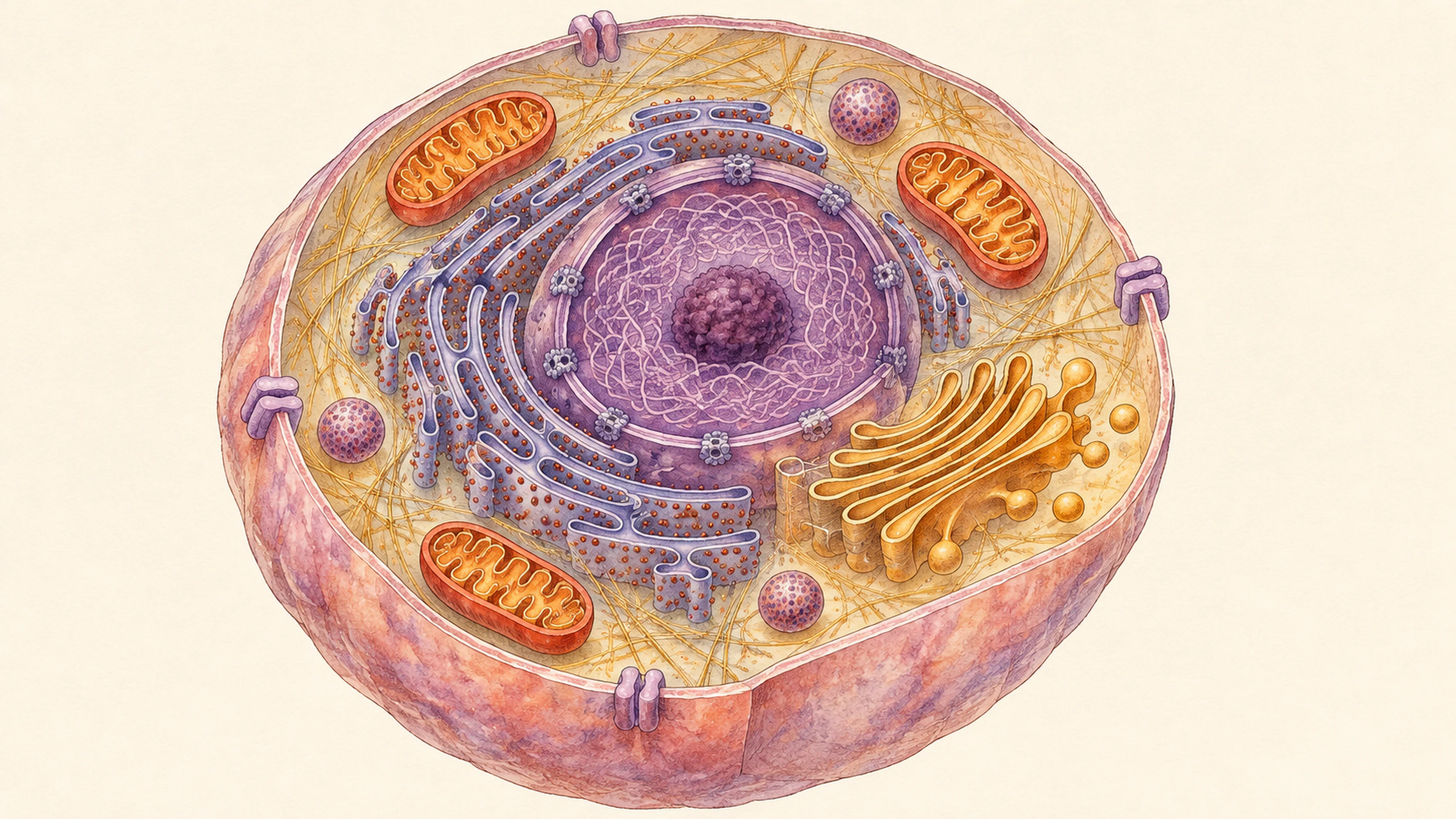
Every part of you is made of cells, far too small to see. Each one is like a tiny town, with a control room, power stations, factories and a post office.
Nucleus
The big round nucleus holds the cell's instructions, written in a long, curly thread called DNA.
- DNA tells the cell what to be and what to make, like a recipe book.
- The darker blob inside, the nucleolus, starts making the cell's little machines.
- Tiny doors in its wall let messages in and out.
Mitochondria
These red, bean-shaped parts turn food into energy, so the cell can work.
- They use the air you breathe in to do it.
- Busy cells, like muscle cells, have lots of them.
- The folds inside give them more room to work.
Ribbons and ribosomes
The folded purple ribbons are covered in tiny dots, ribosomes, which are little factories.
- Ribosomes read the recipe from the DNA and build proteins, the cell's building blocks.
- The ribbons carry the new proteins along, like conveyor belts.
- A busy cell makes thousands of proteins every second.
Golgi
This stack of curved sacs packs the proteins into little bubbles and sends them where they're needed.
- Some bubbles stay in the cell, some go out of it.
- It works like a post office: sorting, wrapping and sending.
- You can see the little bubbles budding off its edges.
Lysosomes
These little round bubbles break down old parts and rubbish so the cell can use them again.
- They're full of juices that dissolve old things.
- They also help fight germs that get inside.
- Nothing in a cell goes to waste.
Cell membrane
The thin membrane holds the cell together and decides what can go in and out.
- Food and water come in, and rubbish goes out, through little doors called channels.
- It's soft and wobbly, not hard like a shell.
- Inside floats a jelly called cytoplasm, criss-crossed by fine threads that hold everything in place.