howthings.work · a picture encyclopedia for small children
The Jumbo Jet
Inside a Boeing 747-400 · by @virpo
Open the interactive cut-away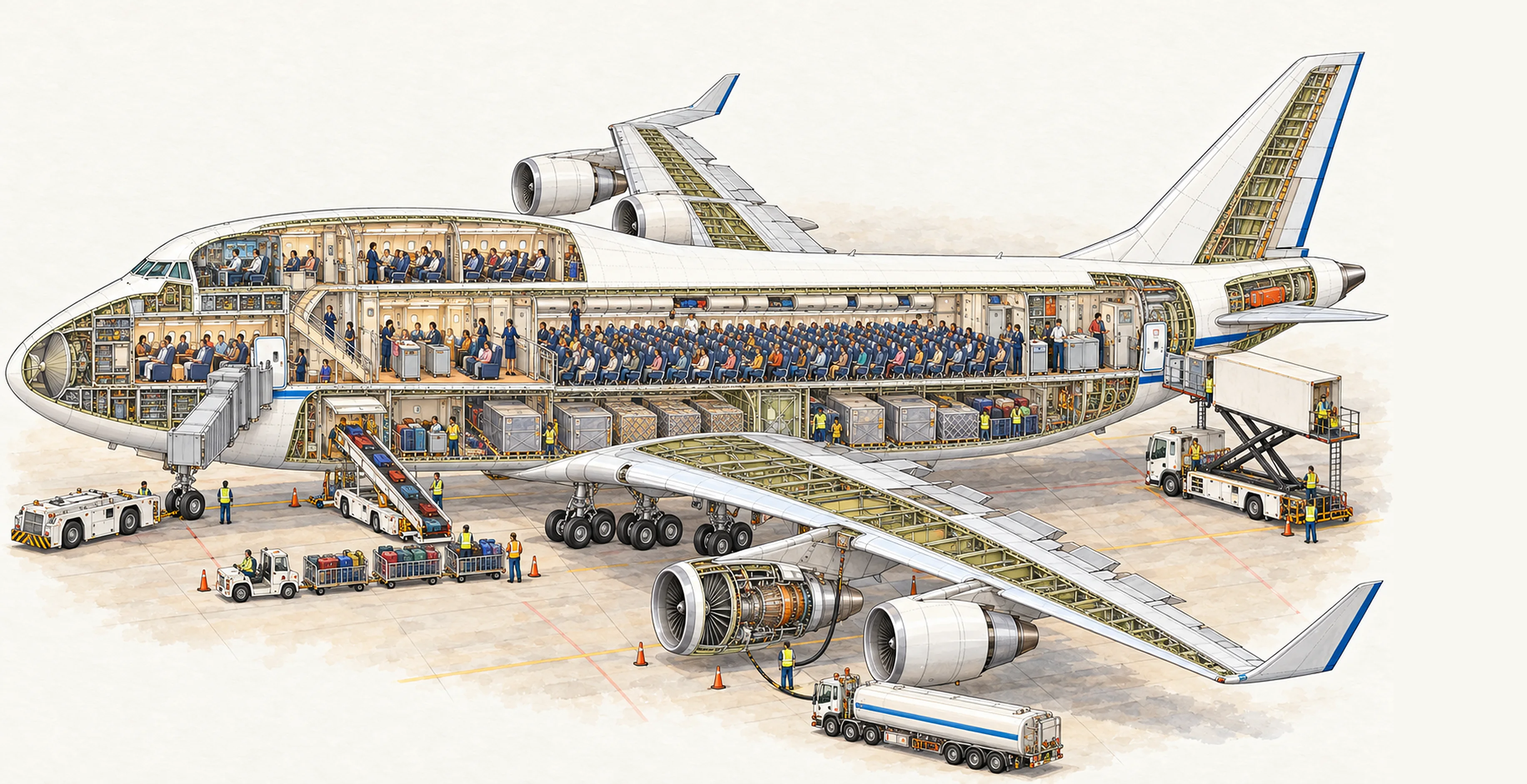
The Boeing 747 was the first wide-body airliner, two aisles wide with a second floor in its hump. This 747-400 is parked at the gate. Its skin is cut away so you can see how hundreds of people, their bags and a whole crew get ready to fly across the world.
Weather radar
Behind the smooth, rounded nose cone hides a radar dish that sweeps from side to side, looking far ahead for storms.
- The radar sends out invisible radio waves. Raindrops and hail bounce them back, and the pilots see the clouds as colored blobs on a screen.
- Green means light rain, yellow is heavier, and red or purple means a big storm the pilots will fly around.
- The nose cone is made of a special material that radio waves can pass through. Metal would block them.
Inside
- Radar antenna: The antenna is a flat round plate covered in tiny slots. It does not need to be curved like a satellite dish.
- Radome: The rounded nose cone is called the radome, short for radar dome. Unlike most of the skin, it is not made of metal.
Flight deck
The pilots sit up here, at the very front of the upper deck, with the whole sky in front of them.
- Two pilots fly the 747-400: the captain on the left and the first officer on the right. Older 747s also needed a flight engineer.
- Six big screens replaced most of the old dials. The cockpit went from 971 lights, gauges and switches down to 365.
- The autopilot can fly the plane for most of the trip, but the pilots watch everything and always do the takeoff themselves.
Inside
- Cockpit windows: The cockpit windows are thick sandwiches of glass and plastic. They are heated from inside.
- Pilots and controls: Each pilot has a control wheel, rudder pedals and a full set of screens, so either one can fly the plane alone.
Electronics bay
Below the cockpit floor is a room packed with shelves of computers. This is the plane's brain.
- These boxes run the autopilot, the radios, the navigation and the screens in the cockpit.
- Fans keep the electronics cool, because all those computers make a lot of heat.
- Engineers can climb down through a hatch to check or swap a box between flights.
Inside
- Computer racks: The shelves are full of boxes that slide in and out like drawers. Each box does one job.
First class
The roomiest seats sit right in the nose, under the cockpit, where it is quiet and far from the engines.
- On many 747s these seats fold flat into a bed for sleeping on long night flights.
- The nose of the 747 is so wide that people sit side by side in a cabin shaped like a rounded room.
- Passengers up front are the first off the plane when it lands.
Inside
- First class seats: Each first class seat is like a small armchair with its own table, lamp and television.
- Passenger door: The big passenger doors on a 747 move inward a little, then slide up into the ceiling.
Upper deck
The bump on top is a whole second floor. It makes the 747, nicknamed the Queen of the Skies, easy to spot.
- The hump was first planned so the 747 could become a cargo plane with a nose that swings open. The cockpit had to sit up high, out of the way.
- The space behind the cockpit was too good to waste, so airlines filled it with seats. Some early 747s even had a lounge bar up here.
- On the 747-400 a staircase connects the upper deck to the main deck below.
Inside
- Staircase: A curving staircase connects the two floors. The 747 was the first airliner with stairs inside.
- Upper deck cabin: Up in the hump, the cabin is narrower and quieter, with its own small windows and storage bins along the sides.
Jet bridge
Passengers walk onto the plane through a moving tunnel that reaches out from the terminal.
- The jet bridge can drive on its own wheels and move up and down to meet the door exactly.
- A soft rubber hood closes around the door, so passengers stay out of the wind and rain.
- Some big airports connect two jet bridges at once, so a full 747 can board faster. A few even reached up to the upper deck.
Inside
- Bridge head: The end of the jet bridge is a small room that can turn and tilt so it lines up with the door.
Passenger cabin
Most travellers ride here, in long rows of seats with two aisles, so you can walk around even at 10 kilometres up.
- In economy there are usually ten seats in each row: three by the window, four in the middle, three by the other window.
- The cabin is pumped full of air so everyone can breathe normally. Outside, the air is far too thin, and about minus 50 degrees.
- Each window has three panes. The middle one has a tiny hole that keeps the air pressure between the panes even.
Fuselage
The plane's long body is a tube made of thin aluminium skin, held in shape by rings and long strips inside.
- The rings are called frames and the long strips are called stringers. Together they work like the bones of the plane.
- The skin is only a few millimetres thick in most places, yet it holds in the cabin air at every flight.
- Windows have rounded corners because round shapes spread the push of the air much better than square ones.
Cargo hold
Beneath the passengers is a huge basement for suitcases, mail and freight.
- Bags are packed into metal containers shaped to fit the round belly of the plane. They roll in on little wheels built into the floor.
- Loose bags go up a conveyor belt truck and into a separate hold at the back.
- Part of the hold is heated, so pets can travel safely too.
Wing and fuel tanks
The wings lift the plane into the sky, and they are also giant fuel tanks.
- Air rushing over the curved wing pushes it upward. That push is called lift.
- Inside, the wing is built like a ladder of ribs and long beams called spars. The fuel fills the spaces in between.
- The 747-400 has little upturned tips called winglets. They make the air swirl less at the wingtip, which saves fuel.
Flaps and ailerons
The wing can change shape. Panels slide out at the back and the front to give extra lift when flying slowly.
- For takeoff and landing, the big flaps slide backward and down. The 747 uses flaps split into three parts.
- At the front, flaps fold down from under the wing's leading edge.
- Ailerons near the wingtips tip up and down to roll the plane into a turn. Spoilers pop up on top to slow it down.
Jet engine
Four huge engines push the 747 forward. Each one is a giant fan with a fire inside.
- The big front fan sucks in air. Most of it blows straight out the back around the engine, and that gives most of the push.
- Some air goes into the middle. It is squeezed, mixed with fuel and burned. The hot gas spins the turbine, and the turbine spins the fan.
- The fire inside is hotter than lava, so the turbine blades are cooled by air flowing through tiny holes in them.
Inside
- Fan: The fan is the big wheel of blades at the front. It does most of the work of pushing the plane forward.
- Compressor: Behind the fan, row after row of small blades squeeze the air tighter and tighter.
- Combustion chamber: In the combustion chamber, fuel is sprayed into the squeezed air and burned in a steady flame.
- Turbine and exhaust: The hot gas rushes out through the turbine and spins it like wind spins a windmill.
Landing gear
The 747 stands on 18 wheels. After takeoff they fold up into the belly, like a bird tucking in its feet.
- Two wheels sit under the nose and steer the plane on the ground. Sixteen more carry most of the weight in the middle.
- The tyres are filled with nitrogen gas instead of air, because it stays steady when the tyres get hot or very cold.
- All 16 main wheels have strong brakes. Together they stop a plane as heavy as about 65 big elephants.
Inside
- Wheels and brakes: Each main gear leg carries a bogie, a frame with four wheels. Inside every wheel is a stack of brake discs.
- Shock strut: The tall shiny leg is a giant shock absorber. It squashes when the plane lands and gently springs back.
Galley
The galley is the plane's kitchen. Meals are cooked on the ground, then heated in small ovens during the flight.
- Food and drinks arrive in metal trolleys from the catering truck. The same trolleys roll down the aisle at mealtime.
- Up high your sense of taste gets weaker, so airline food is often made a little saltier and spicier.
- Everything has a latch or a lock, so nothing can slide around if the plane bumps through some turbulence.
Inside
- Meal trolleys: The metal trolleys are the same standard size on most planes, so they slide into any galley.
- Ovens: Galley ovens do not cook food from raw. They only heat meals that were cooked in a kitchen on the ground.
Pressure bulkhead
At the back of the cabin is a big dome shaped like an umbrella. It seals in the air that passengers breathe.
- Behind the dome, the tail is open to the outside air. In front of it, the cabin is pressurised.
- A dome shape is very strong, the same way an egg is hard to squeeze from its ends.
- Inside the cabin it feels like being on a mountain about 2,400 metres high, even when the plane flies at 11,000 metres.
Tail
The tall fin and the small back wings keep the plane flying straight, like the feathers on an arrow.
- The rudder on the fin swings left and right to turn the nose left or right.
- The elevators on the small back wings tip up and down to point the nose up or down.
- The top of the fin is 19.4 metres above the ground, as tall as a six-storey building.
Inside
- Fin structure: Inside, the fin is built like a small wing standing upright: two strong beams with ribs between them.
- Rudder: The rudder is the tall flap on the back edge of the fin. Swinging it left or right turns the nose left or right.
- Horizontal stabiliser: The small back wing is the horizontal stabiliser. The elevators hinged to its back edge point the nose up or down.
Auxiliary power unit
The very tip of the tail holds a small jet engine. It powers the plane while it waits at the gate.
- It is called the APU. It makes electricity for the lights and the kitchen, and air for keeping the cabin cool.
- Its air is also used to start the four big engines before the plane leaves the gate.
- If you see a little shimmer of heat at the end of the tail on the ground, the APU is running.
Inside
- APU engine: The APU is a small jet engine about the size of a fridge, hidden inside the tail cone.
- APU exhaust: The APU's hot exhaust comes out of the pointed tip of the tail, as far from people as possible.
Flight recorders
Everyone calls them black boxes, but they are bright orange so they are easy to find.
- There are two. One records hundreds of measurements, like speed and height. The other records the voices in the cockpit.
- They sit near the tail and are built to be extremely tough, with thick armour and insulation.
- Engineers use the recordings to learn how to make flying even safer.
Pushback tug
A jet cannot drive backward on its own, so a strong tug pushes it away from the gate.
- The tug is low and very heavy, so its wheels can grip the ground while it pushes a plane far bigger than itself.
- It connects to the nose wheel, either with a long bar or by lifting the wheel right off the ground.
- During pushback, the tug driver talks to the pilots through a headset plugged into the plane.
Inside
- Towbar: The towbar is the strong metal arm that links the tug to the nose wheels.
- Nose landing gear: The nose gear has two wheels. It steers the plane when it drives slowly on the ground.
Baggage team
Every suitcase gets a paper tag with a barcode, so it ends up on the right plane.
- Machines in the airport read the tags and sort the bags. Then a little tug pulls them to the plane on a train of trolleys.
- The belt loader is a moving ramp. Baggage handlers put bags on the bottom and they ride up into the hold.
- Inside the hold, the bags are packed tightly so they cannot slide around during the flight.
Inside
- Belt loader: A belt loader is a moving ramp on wheels. It carries suitcases from the ground up into the hold.
- Baggage carts: A little tug pulls a train of baggage carts from the airport's sorting hall to the plane.
Fuel truck
Jet fuel goes in from underneath the wing, through a hose clipped into a panel there.
- Jet fuel is a kind of kerosene. It smells a little like the oil in an old lamp.
- A 747 needs more fuel than one truck can carry. At big airports the fuel often comes through pipes under the ground, and the truck pumps it into the plane.
- The fueller watches the gauges, and the plane's computers make sure each tank gets the right amount.
Inside
- Refuelling point: Fuel goes in through sockets under the wing. The hose snaps on with a tight seal, so not a drop is spilled.
Catering truck
This truck brings all the food and drinks. Its whole box lifts up to the door on folding scissor arms.
- The door of a 747 is about five metres above the ground, higher than a double-decker bus.
- The crew roll trolleys of meals, drinks and ice straight from the truck into the galley.
- On the way back, the truck takes away the empty trolleys and rubbish from the last flight.
Inside
- Catering box: The white box on top of the truck is a small cold room on stilts, full of meal trolleys.
- Scissor lift: Folding metal arms, crossed like a pair of scissors, push the box straight up into the air.