howthings.work · a picture encyclopedia for small children
The City Tram
Inside a low-floor tram · by @virpo
Open the interactive cut-away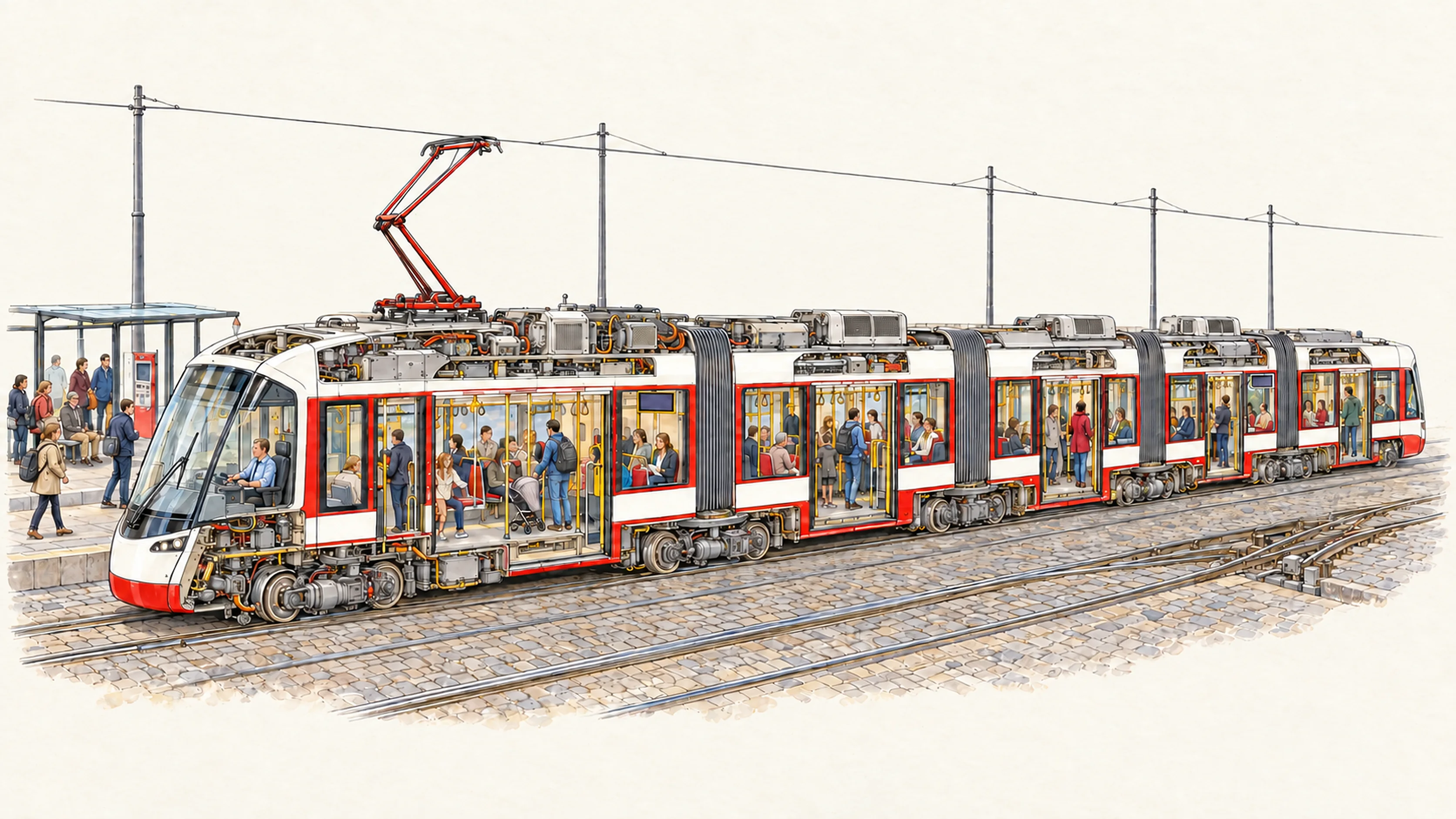
A modern city tram is a long electric train that runs in the street. Its floor is low enough to walk straight in, and it bends in the middle to get around corners. Its skin is cut away here to show how it works.
Pantograph
The folding arms on the roof are the pantograph. They push a strip up against the wire and collect the electricity that drives the tram.
- Springs push the arms up all the time, so the strip stays touching the wire even over bumps.
- The strip at the top is made of carbon, like a very hard pencil lead. It slides along the wire and wears out instead of the wire.
- When the tram goes to sleep in the depot, the driver lowers the pantograph with a button.
Inside
- Contact strip: At the very top is a bar with a strip of carbon. It is the only part of the tram that touches the wire.
- Arms and springs: The arms fold like a knee. Big springs push them up all the time, so the strip stays on the wire even over bumps.
- Insulators: The pantograph stands on little ridged feet called insulators. They stop the electricity from getting into the tram's metal body.
Overhead wire
A single copper wire hangs above the tracks along the whole city. It is how the electricity reaches the tram.
- The wire is held up by thin cross-wires on poles, and pulled tight with heavy weights so it does not sag in summer.
- It zig-zags a little from side to side, so it does not wear a groove in one spot of the pantograph strip.
- The electricity goes down through the tram, into the motors and back home through the rails.
Roof equipment
Because the floor is so low, there is no room for machines underneath. So most of them live on the roof.
- Boxes called inverters change the electricity from the wire into exactly what the motors need, to go faster or slower.
- Air conditioning units keep the passengers cool in summer and warm in winter.
- When the tram brakes, the motors make electricity. If nobody else can use it, it is turned into heat in a box called a resistor.
Driver's cab
The driver sits behind the big front window. There is a desk with screens and one handle that makes the tram go and stop.
- There is no steering wheel! The rails steer the tram. The driver only chooses how fast it goes.
- Push the handle forward to speed up, pull it back to brake. In the middle the tram just rolls.
- Many trams have a cab at both ends, so at the end of the line the driver simply walks to the other end and drives back.
Inside
- Speed handle: The driver controls the tram with one handle. Forward makes it go faster, back makes it slow down.
- Windscreen: The big curved window gives the driver a wide view of the street, the people and the cars.
- Ticket machine: At the stop, a machine sells tickets. You choose a ticket and pay with coins or a card.
Motor bogie
Under the tram are bogies: small frames with four wheels each. Some of them have electric motors that turn the wheels.
- The electric motor spins very fast, so a gearbox slows it down and makes it stronger before it turns the wheels.
- The bogie can swivel a little, so the tram can follow curves in the track.
- Rubber springs between the wheels and the tram make the ride smooth and quiet.
Inside
- Motor and gears: The electric motor spins very fast. A box of gears slows it down and makes it strong enough to push the heavy tram.
- Steel wheel: Tram wheels are steel, with a small rim on the inside. The rim runs in the groove of the rail and keeps the tram on the track.
- Sand box: When the rails are wet or icy, the wheels can slip. So the tram can sprinkle a little sand in front of them.
Passenger saloon
Inside, the tram is one long room. People sit, stand and hold on to the yellow poles and straps.
- The poles are bright yellow so they are easy to see and grab when the tram starts or stops.
- There is a wide space with no seats for pushchairs and wheelchairs.
- Screens show the name of the next stop, and a voice says it too.
Doors and low floor
The floor is so low that you walk straight in from the stop, without any steps. That is why it is called a low-floor tram.
- To keep the floor low, the wheels hide under the seats and the machines live on the roof.
- The doors slide open wide, so many people can get on and off quickly.
- Rubber edges on the doors feel if someone is in the way, and the doors open again.
Articulation
A long tram is made of several sections, joined by bendy joints. It can wiggle around tight city corners like a caterpillar.
- The black folds are like an accordion. They stretch on the outside of a curve and squeeze on the inside.
- Inside the joint, the floor is a round turning plate, so you can walk from one section to the next.
- Without joints, a tram this long could never get around the corners of old streets.
Wheels and brakes
The wheels are made of steel, and they roll on steel rails. That is why trams are so smooth and use so little energy.
- Normally the motors brake the tram, and make electricity while they do it.
- Disc brakes, like on a bicycle, hold the tram still at the stop.
- For an emergency, magnets drop down onto the rails and grip them hard.
Grooved rails
Tram rails are set into the street, level with the cobbles, so cars and bikes can cross them.
- Each rail has a narrow groove. The rim on the inside of the wheel runs in it and keeps the tram on the track.
- The rails also carry the electricity back to the power station.
- Cyclists cross tram rails at a steep angle, so their tyre does not slip into the groove.
Switch points
Where tracks split, a switch decides which way the tram goes. The tram cannot steer, so the track steers it.
- Two thin steel blades slide sideways. They guide the wheels onto the left or the right track.
- A small motor in a box under the street moves the blades. Some switches are worked by the driver from the cab.
- In winter, little heaters in the switch melt the snow so the blades can still move.
Inside
- Switch blades: The switch blades are long thin pieces of rail. They slide sideways to point the wheels one way or the other.
- Switch motor: Under a steel lid in the street is a small motor. It pushes and pulls a rod that moves the blades.
Tram stop
At the stop, people wait under a glass shelter. The kerb is raised so it is level with the tram floor.
- A ticket machine sells tickets, and some trams have one on board too.
- A screen at the stop tells you how many minutes until the next tram.
- Stand behind the line on the kerb until the tram has stopped.